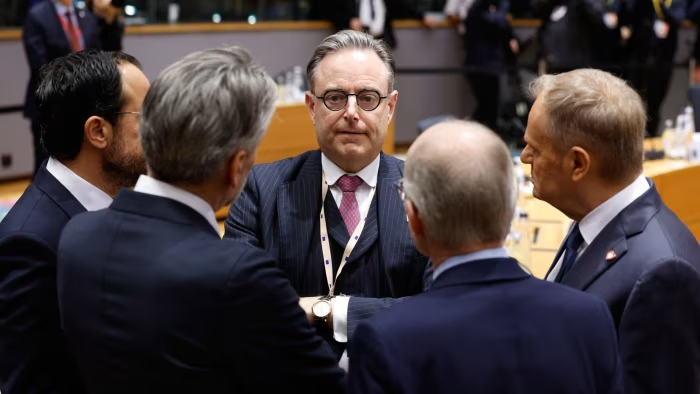
EU leaders vowed to find the money to cover Ukraine’s financing needs at a summit in Brussels on Thursday, even as Belgium restated its unwavering opposition to using Russia’s frozen assets.
The bloc is seeking to use €210bn in Moscow’s sovereign assets held in Euroclear, the central securities depository based in Belgium, to guarantee a €90bn loan to Kyiv over the next two years. The money is intended for Ukraine to fend off Russian aggression and ensure Europe has an important role in US-led peace talks, despite Russia threatening a “harsh” legal response.
EU officials said they were hopeful of a deal even if it meant meeting through the night. The summit is scheduled to end on Friday but could be extended. European Council president António Costa vowed that leaders would “never leave” the summit until an agreement was struck.
A senior German official said there was “widespread readiness to reach an agreement”, adding that there was “movement”.
“We’re going in the right direction but we’re not there yet,” the official said.
Ukraine’s President Volodymyr Zelenskyy attended the meeting in person, adding to pressure on Belgium, which has sought financial and legal guarantees that any potential retaliation from Russia would be shared with other EU member states.
“I very much hope that we can obtain a positive decision. Without this, there will be a major problem for Ukraine,” Zelenskyy told reporters on Thursday. “Today it depends on political will.”
“If Ukraine does not have these funds, it is in a much weaker position. [Russian President Vladimir] Putin’s temptation to try to seize us grows, because we find ourselves in a situation where we lack money for basic needs and for weapons,” Zelenskyy said.
Belgium’s Prime Minister Bart De Wever told reporters on Thursday morning that he could not agree to the text until certain “deal breakers” were removed. “Otherwise, they will have to carry me out of there. There can be no flexibility on issues that threaten the financial security of Euroclear and Belgium. Let that be very clear,” he said.
“I have not yet seen any text that would persuade me to change Belgium’s position. I hope to see one today, but so far there is none,” he added.
De Wever and Zelenskyy met on the sidelines of the summit. Zelenskyy said afterwards: “I understand the risks [De Wever] is talking about, but I think we have bigger risks.”
“Whether it turned out to be productive, we will see. We need a little time,” the Ukrainian leader added.

Senior EU officials met De Wever and other Belgian officials on Wednesday night, according to people briefed on the talks. They made progress on legal guarantees, but sticking points remain on a liquidity provision to ensure rapid access to cash should Russia need to be repaid, and the protection afforded to Euroclear assets in Russia, the people added.
Instead of using the frozen assets, De Wever has advocated joint borrowing by EU countries guaranteed by the bloc’s common budget.
The European Commission has said this will require unanimous approval, with Hungary already signalling it would veto the move. Countries including Italy have banded together with Belgium in favour of alternative options to using the frozen assets.
“The real clash is between those who want joint debt and those who oppose it,” such as Germany, the Netherlands and other so-called “frugal countries”, said a senior EU diplomat.
The EU on Thursday imposed sanctions on 41 oil tankers that it said were part of Russia’s “shadow fleet” transporting crude in violation of a western-imposed price cap. The move means almost 600 of the ships are now subject to EU curbs.
Kaja Kallas, the EU’s foreign policy chief, said Belgium was “under a lot of pressure from Russia, from European countries but also from the United States”.
The Kremlin has said it will not accept any Ukrainian or European revisions to US President Donald Trump’s peace plan. Putin described European leaders as “swine” on Wednesday and said Russia was open to resuming diplomacy with the continent “if not with the current politicians, then when the political elites in Europe are replaced”.
Moscow has increased its provocations against Nato’s eastern members in recent months, with drones and fighter jets breaching their airspace. On Wednesday, three Russian border guards briefly entered Estonian territory, prompting Tallinn to summon the Russian charge d’affaires in response. In another threatening move, Belarus said on Thursday it had deployed Russia’s new Oreshnik hypersonic missile system.
Arriving at the summit, Poland’s Prime Minister Donald Tusk said leaders either had to agree “money today or blood tomorrow”.
“I’m not talking about Ukraine, I am talking about Europe. This is our decision to make and only ours. All European leaders have to rise to this occasion,” Tusk said.
However, Hungary’s Prime Minister Viktor Orbán said the opponents had enough votes to block a deal being struck over Belgium’s head. “The whole idea is a stupid one. It is marching into the war. The Belgian prime minister is right. We should not do that,” he told reporters.
Zelenskyy told a press conference in Brussels that Kyiv needed the money for drones and other weapons. Ukraine had run out of missiles for some air defence systems, he said.
Without the loan, he said, “the production of drones will be reduced by several times”.
Additional reporting by Paola Tamma in Brussels and Richard Milne in Oslo